
Hot off the press, yesterday evening, 29 September 2026, the German Government’s expert committee presented the eagerly awaited proposal for a new “location clause” (Standortklausel) to incentivize pharmaceutical R&D and manufacturing in Germany. Under this proposal, pharmaceutical companies can apply for a reduction or complete waiver of the just recently enacted 8.5% additional “manufacturer markdown” (Herstellerabschlag). So, what does this newly proposed German location clause mean for pharmaceutical companies?
This blog outlines the proposed location clause and summarizes initial stakeholder reactions. We also discuss whether the proposal would really be an improvement for pharmaceutical companies or rather a bureaucratic worsening compared to the currently applicable exemption.
I. Background
In July 2026, the German Parliament passed the highly controversial GKV-BStabG, which introduced significant cost-cutting measures to the pharmaceutical pricing and reimbursement system. We discussed the GKV-BStabG and these measures extensively in an earlier blog.
The GKV-BStabG introduced an additional manufacturer markdown obligation for pharmaceutical companies in the amount of 8.5% of their medicines’ sales price. This will apply to a wide range of patent-protected medicines from 1 January 2027. Together with the already existing 7% markdown payment obligation, this increases the total statutory markdown obligations to 15.5% of the manufacturer’s sales price.
The GKV-BStabG also introduced an exemption rule under which companies can get a waiver from this new 8.5% markdown. The current exemption was also considered to be a “location clause” as it applies only to medicines whose clinical trials had at least 5% of study participants enrolled in Germany. In that case, such medicine can be exempted from the 8.5% markdown obligation. This is the current legal situation that we highlight as we will discuss below whether the newly proposed location clause would really improve the situation for the pharmaceutical industry. As the title of this blog implies, we have doubts…
Despite this available exemption, the additional 8.5% markdown raised significant concerns about its impact on pharmaceutical investment, research, production, and product launches in Germany. This new markdown sits uneasily with the government’s actual goal of promoting the pharmaceutical industry as a German Leitwirtschaft, meaning an industry considered strategically important for the country.
Therefore, alongside the GKV-BStabG, the German Parliament passed a resolution asking the German Government to examine exemptions from the additional markdown that can encourage pharmaceutical R&D and manufacturing in Germany. As a reaction to this resolution, the expert committee that presented yesterday’s proposal was set up. The committee was requested to finalize its proposal until today (30 September 2026), so that a new “location clause” could be passed and take effect on 1 January 2027. The expert committee has now presented its proposal for a new “location clause”.
II. The Proposed Location Clause
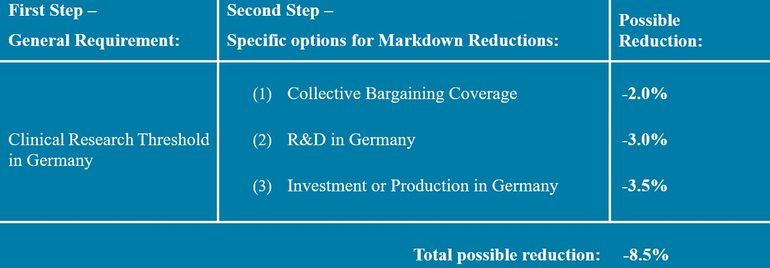
The expert committee proposes a two-step mechanism:
- First Step: The pharmaceutical company must meet a mandatory clinical research threshold.
- Second Step: If the threshold is met, the additional manufacturer markdown can then be reduced for the pharmaceutical company’s entire portfolio based on three further criteria relating to the company’s activities in Germany.
First Step:
To qualify at all for a markdown reduction, a pharmaceutical company first has to show that at least 2% of participants of its clinical trials were enrolled at trial sites in Germany. The basis for the 2% (i.e., the 100%) are all of the company’s Phase I-III clinical trials that were listed in the EU’s CTIS database in the last three calendar years. This threshold is proposed to increase gradually from 2% to 4%.
In contrast to the currently existing exemption (“5% study participants in Germany”), this newly proposed clinical trial requirement is not limited to trials with a particular medicine but encompasses all of the company’s studies in the CTIS. This is an important difference to note.
Another important difference to note is that – unlike the existing “5% location clause” – meeting the new first-step-threshold for clinical trials does not itself reduce the markdown payment. Instead, it would make the pharmaceutical company eligible to enter the second step assessment with the above-listed reduction options. A company that misses the first-step threshold would drop out of the process right away and cannot get any reduction, even if it should meet all or some of the eligible options in the second step.
Second Step:
The expert committee’s proposal envisages the following options for reductions of the 8.5% markdown payment obligation:
- Collective Bargaining Coverage (Tarifbindung): If the pharmaceutical company’s German operations are bound by a collective bargaining agreement with a trade union, the additional manufacturer markdown would be reduced by 2%.
- R&D in Germany: If the pharmaceutical company spends at least 7% of its turnover with the German statutory health insurance system (GKV) on pharmaceutical R&D in Germany, the additional manufacturer markdown would be reduced by 3%. R&D carried out by contractors would also count.
- Investment or Production in Germany: If the pharmaceutical company satisfies at least one of the following conditions, the additional manufacturer markdown would be decreased by another 3.5%:
- If the company has invested at least EUR 500 million in fixed assets in Germany over the past five years;
- The value of its pharmaceutical manufacturing in Germany, including qualifying contract manufacturing, equals at least one-third of its German GKV turnover; or
- If the company operates at least one site in Germany that is classified as critical infrastructure (a “high bar” in Germany).
These reductions are envisaged to apply individually and, if applicable, cumulatively. Hence, a company meeting all 3 requirements would achieve a total reduction of the markdown of 8.5%, effectively resulting in a waiver from the new additional manufacturer markdown. Then, only the general 7% manufacturer markdown would continue to apply.
The expert committee states that the proposal is open to companies regardless of their size or country of origin and headquarters. The committee also recommends involving the European Commission because the preferential treatment could raise questions under EU state aid and internal market law. This additional review would likely cause significant delays to the legislative procedure.
III. First Stakeholder Reactions
In first reactions, pharma industry stakeholders have mostly welcomed the expert committee’s proposals. They continue, however, to call for broader reform of the German statutory health insurance system. Their main focus appears to be the AMNOG process, which is Germany’s system for determining the benefit and reimbursement price of new medicines. Among other things, the industry wants a framework that better supports pharmaceutical innovation. Having said this, recent ideas for an “AMNOG 2.0” from sources close to the German Government do not sound very promising for the industry. However, this remains to be seen since the AMNOG reform is separate from this “location clause” reform.
In contrast to the industry voices, the payer side represented by the National Association of Statutory Health Insurance Funds (GKV-Spitzenverband) is much more critical and against the proposed location clause. It warns that the proposal could cut the expected savings for the health insurance system by up to EUR 1.3 billion, undermining the goal of stabilizing contribution rates. The health insurance funds rather favor a “cost-neutral” model under which companies that fail to meet the location criteria should pay higher markdowns, which would effectively fund the reductions granted to qualifying companies.
The health insurance funds also argue that they should not pay for general pharmaceutical industry policy, but rather have this funded by other budgets or by the pharmaceutical industry itself.
IV. Is the proposed location clause an improvement or worsening? And what’s next…
Generally, the expert committee’s proposal sends a positive signal to the pharmaceutical industry. It recognizes that pricing rules directly affect where companies choose to conduct research, manufacture medicines, and invest. For now, however, the exemptions are only a proposal, and it is likely that the German legislator will further modify them before adoption.
Furthermore, the practical benefit of the proposed location clause should also not be overstated. Even a pharmaceutical company that meets every requirement would simply avoid paying the new 8.5% additional markdown and only return to the general 7% manufacturer markdown. Thus, meeting every requirement would only remove additional burden that the Government just imposed on pharmaceutical companies. Hence, the new location clause would not create any financial reward or new incentive for investing in Germany.
More pertinently, it appears questionable whether the newly proposed location clause is really that much more beneficial for pharmaceutical companies than the currently applicable exemption with the waiver of the 8.5% additional markdown per product if at least 5% of study participants were enrolled in Germany. Under the expert committee’s new proposal, a full waiver will require pharmaceutical companies to cumulatively meet many more and also more burdensome requirements. The new proposal will also create new bureaucracy and significant administrative burden for all sides and not only for the pharmaceutical companies, even though it does not really introduce a genuine new financial benefit.
The legislator now has until 1 January 2027, when the additional manufacturer markdown takes effect, to decide whether and how to implement the location clause. In the coming months, it will need to resolve the financing and EU law questions and turn the proposal into a clear and workable statutory framework. This process will surely be accompanied by intensive advocacy activities from all stakeholders of the German drug pricing and reimbursement system. Pharmaceutical companies and industry stakeholders should therefore closely follow these legal and policy developments.
The Life Sciences Team of Covington & Burling LLP in Frankfurt (Germany) will continue monitoring the developments in this area and is well positioned to assist clients in navigating the impact of the GKV-BStabG and the proposed location clause on their German and international pricing, reimbursement and market access strategies.
***