
Bart Van Vooren and Yuliya Gevrenova
The Nagoya Protocol was adopted under the Convention on Biological Diversity (“CBD”) and is built on the idea that the commercial use of materials from nature (“genetic resources”) should translate into fair and equitable benefits for countries providing and protecting nature in their jurisdictions. For the first time since the Nagoya Protocol entered into force in 2014, governments have published reports on the implementation of their access and benefit-sharing (“ABS”) systems.
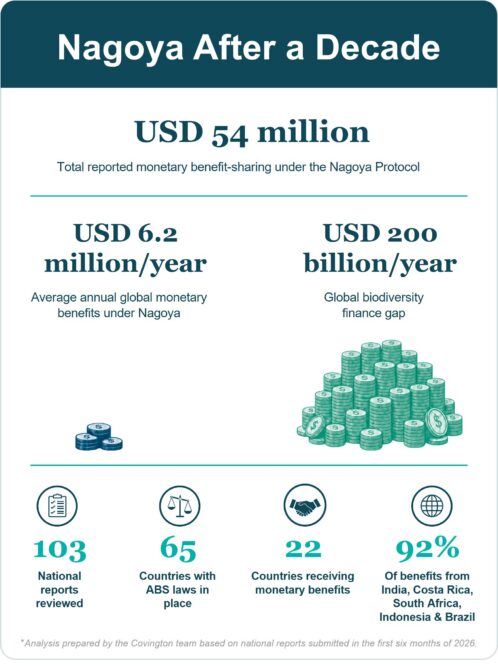
Our team reviewed and extracted data from all one hundred and three (103) national reports that were uploaded during the first half of 2026. The analysis shows that countries with ABS legislation have collectively received approximately USD 54 million over the reporting periods covered by the national reports since the Nagoya Protocol entered into force.
In this article, we will (i) analyze the reported data and identify key findings; (ii) consider what the findings may mean for governments, companies, and biodiversity policymakers more broadly; and (iii) examine whether emerging approaches under the CBD, including the new multilateral mechanism for benefit-sharing (“MLM”) from digital sequence information (“DSI”), may offer an alternative to achieve significant finance for biodiversity.
1. Monetary Benefit Sharing under the Nagoya Protocol Benefit-Sharing Model
Currently, there are 142 Parties to the Nagoya Protocol, with Armenia about to become the 143rd. When implemented into national law, companies seeking access to genetic resources may be required to obtain an authorization from the country of origin and agree to share monetary and/or non-monetary benefits. Monetary benefits, which are the focus of this article, typically take the form of access fees, milestone payments, royalties, or annual license fees.
Of the one hundred and three (103) countries that submitted national reports, sixty-five (65) reported having national ABS legislation in place, a figure that we independently verified through our review of national legal frameworks. Of those, only twenty-two (22) reported having received monetary benefits. The other countries expressly reported receiving “zero” monetary benefits or left the reporting section blank.
For the twenty-two (22) countries reporting monetary benefit-sharing, the average reporting period was approximately 8.5 years.1 Across that period, the total reported monetary benefit-sharing amounted to approximately USD 50 million. In addition, several countries reported receiving approximately USD 4 million in monetary benefits related to associated traditional knowledge (“aTK”), bringing the combined reported total to approximately USD 54 million. Our findings are broadly consistent with the synthesis prepared by the CBD Secretariat for SBI-7, which reported substantially similar figures based on its review of the first national reports.2
Annualized across the average 8.5‑year reporting period,3 the 22 countries with ABS laws have received cumulatively on average USD 6.2 million per year. This corresponds to an annual average of USD 280,000 per country with ABS laws reporting having received benefits; or USD 96,000 across all 65 countries that have ABS laws.
Unsurprisingly, a significant proportion of the reported monetary benefits originates from a small number of megadiverse countries. Collectively, India, Costa Rica, Indonesia, Brazil, and South Africa account for approximately USD 49.4 million of the USD 54 million reported globally (equivalent to roughly 92% of all reported monetary benefit-sharing under the Nagoya Protocol). However, the distribution within this group is highly uneven:
- India reported approximately USD 35.1 million in monetary benefits over a period of around 8 years and 2 months, averaging USD 4.2 million a year.
- Costa Rica reported approximately USD 5.3 million over a period of around 7 years and 2 months, averaging approximately USD 742 thousand per year.
- South Africa reported approximately USD 4.6 million over a period of around 7 years and 8 months, averaging USD 600 thousand a year.
- Indonesia reported approximately USD 2.4 million over a period of around 7 years, averaging USD 340 thousand a year.
- Brazil reported approximately USD 2.0 million over a period of around 25 years, averaging USD 80 thousand a year.
We note that out of the twenty-two (22) countries that reported benefit-sharing, fourteen (14) national ABS laws cover both physical genetic resources, and related DSI. These include Brazil, Costa Rica, India and South Africa.
2. What can we learn from a decade of bilateral Benefit-Sharing?
The figures revealed by the national reports require cautious interpretation given reporting limitations, particularly when assessing what they tell us about who pays, who benefits, and whether the existing benefit-sharing mechanism under the Nagoya Protocol can meet financing needs for biodiversity.
a. Do companies face barriers to sharing monetary benefits?
It might be tempting to read the low aggregate numbers as evidence that commercial entities are avoiding sharing benefits when they access and use biodiversity. That is not our experience.
Covington Partner Bart Van Vooren first started advising on ABS nearly fifteen years ago. In our legal practice, we find that multinationals across the life sciences commonly spend far more on legal and operational compliance than on monetary benefit‑sharing itself. As we have reported on numerous occasions (see our alert on the 10 year anniversary of the Nagoya Protocol), with more than one-hundred (100+) national ABS laws across the globe, companies must establish complex standard operating procedures, tracking and tracing systems, and compliance functions to satisfy both provider and user country requirements. These compliance costs can range from several hundred thousand USD to several million USD per year for a single large company; with some outliers annually exceeding ten (10) million USD.
That cost of ABS compliance under the Nagoya Protocol is striking because the expenditure of one or just a few companies exceeds the annual monetary flows reported under the Nagoya Protocol. This permits two conclusions: (1) companies actively seek to understand and comply with ABS laws applicable to their research and development activities; but (2) the current design of benefit-sharing under the CBD and Nagoya Protocol results in a staggeringly high compliance and transaction cost that absorbs most financial resources without assigning them to biodiversity conservation and restoration.
b. How much of the reported Revenue is actually reaching Biodiversity?
The headline figures reported by governments cannot be equated to direct investment into biodiversity conservation and restoration.
Reported monetary benefits do not account for the public costs of designing, administering, and enforcing national ABS systems. Nor do the national reports consistently track how the revenues collected through ABS are ultimately allocated or spent. As a result, an important policy question remains unanswered: not how much money is collected through benefit-sharing, but how much of that money ultimately reaches biodiversity conservation and restoration activities?
The limited data that are publicly available suggest caution. For example, public financial reports from the administrator of Brazil’s National Benefit-Sharing Fund4 indicate that at least USD 315,000 was spent on fund administration and related operational expenditures between 2020 and May 2025 (equivalent to approximately 16% of the USD 2.0 million in monetary benefit-sharing reported by Brazil). These costs were borne by the Fund itself, which is financed primarily through monetary benefit-sharing payments collected under Brazil’s ABS framework. Importantly, this figure captures only the costs associated with administering the Fund and does not include the broader costs of developing legislation, reviewing permit applications, operating compliance systems, or undertaking enforcement activities. The true cost of implementing national ABS frameworks is therefore likely to be higher, though available data do not permit a reliable assessment of how much of the reported revenue ultimately reaches biodiversity conservation and restoration on the ground.
c. Can bilateral benefit‑sharing help close the global biodiversity finance gap?
The USD 54 million reported under the Nagoya Protocol, combined with the high compliance cost noted above, stand in stark contrast to the USD 200 billion per year global biodiversity financing gap identified by countries in 2022.
Even if reporting were perfect and every dollar were directed to conservation, bilateral monetary benefit‑sharing as currently organized would cover only a small fraction of global needs.
This reality underlines why the 2022 Kunming‑Montreal Global Biodiversity Framework calls for much broader private‑sector participation and innovative finance solutions, including a new multilateral benefit‑sharing mechanism for DSI.
3. The way forward: From bilateral transaction-based ABS to scalable multilateral biodiversity finance
The national reports show that ABS frameworks can generate monetary benefits, particularly where countries have established functioning systems and where users are able to navigate the legal requirements with relatively little friction. At the same time, the Nagoya Protocol was never only about finance: it embodies a broader cultural shift under the CBD recognizing genetic resources as part of national natural heritage. Nevertheless, from a financial perspective, the reports clearly show that the Nagoya Protocol and its reliance on thousands of national, bilateral negotiations is not likely to close the USD 200 billion biodiversity finance gap.
The central lesson is one of scale. Bilateral ABS was designed to ensure fairness in individual cases of access and utilization, reflecting the exceptional scenario that a 1-1 relationship exists between a natural resource and a blockbuster product. It was not designed to close a global biodiversity finance gap measured in billions of dollars per year. Nor was it designed for a scientific and commercial environment in which research increasingly relies on digital data, global databases, cross-border collaborations, automated analysis, and complex supply chains.
This is why the decision taken by the 196 Parties to the CBD to create a “multilateral solution” for benefit-sharing is so important. If properly designed, the new MLM could reduce transaction costs, and generate more predictable revenue than bilateral ABS under Nagoya could ever achieve.
However, financial ambitions can only be achieved if legal certainty for companies is guaranteed. This issue is also reflected in the draft recently published by the CBD Secretariat. While the study’s assumptions and projections remain subject to ongoing discussion and scrutiny, it estimates that the MLM could generate between USD 5 million and USD 1 billion annually. Importantly, the study suggests that the upper end of this range is attainable only if the MLM provides clear rules on who is expected to contribute, what natural resources are covered, how contributions are calculated, and whether participation in the multilateral mechanism eliminates exposure to national ABS obligations under the Nagoya Protocol.
As we approach the 17th Conference of the Parties (“COP”) to the CBD in Armenia this October, governments are actively exploring how to implement the MLM. As a member of the MLM Steering Committee, Covington Partner Bart Van Vooren closely follows and contributes to these developments. Life sciences companies, too, are taking proactive steps to explore how this multilateral approach can bring the world closer to meaningful, scalable solutions for global biodiversity preservation and finance.
***
Should you require additional information about the Nagoya Protocol national reports or wish to engage in the ongoing negotiation process on the MLM, the Covington team is available to support you. Please do get in touch with Bart Van Vooren: bvanvooren@cov.com
***
Mathilde Raebisch of Covington & Burling LLP contributed to the preparation of this article.
- While reporting periods differ and do not fully overlap, the submissions collectively indicate monetary benefit-sharing taking place over approximately 7.9 years (2018–2025). Brazil is an outlier, reporting for a period of approximately 25 years, from 01 June 2000 till 30 June 2025, which skews the average reporting period up by almost a year. ↩︎
- The CBD Secretariat’s synthesis report prepared for SBI-7 reported approximately USD 53 million in monetary benefits. The small difference compared to the figures presented in this article is likely attributable to rounding, currency conversion, and differing interpretations of information reported by Parties. For this reason, all figures should be treated as approximate estimates. ↩︎
- We divided each country’s reported total amount by its respective reporting period and aggregating the resulting annual values. ↩︎
- Nota Técnica AF/DEREI nº 09/2025, Prestação de contas da gestão financeira dos recursos monetários do FNRB para Comitê Gestor do FNRB, available at: https://www.gov.br/mma/pt-br/assuntos/bioeconomia/patrimonio-genetico/reparticao-de-beneficios/fundo-nacional-para-a-reparticao-de-beneficios/NotaAFDEREI_09_2025PrestaodeContasFNRB_2025janmaio.pdf ↩︎